


Why Is the jack thrown between 6 and 10 meters in petanque?
Why Is the jack thrown between 6 and 10 meters in petanque?
Introduction
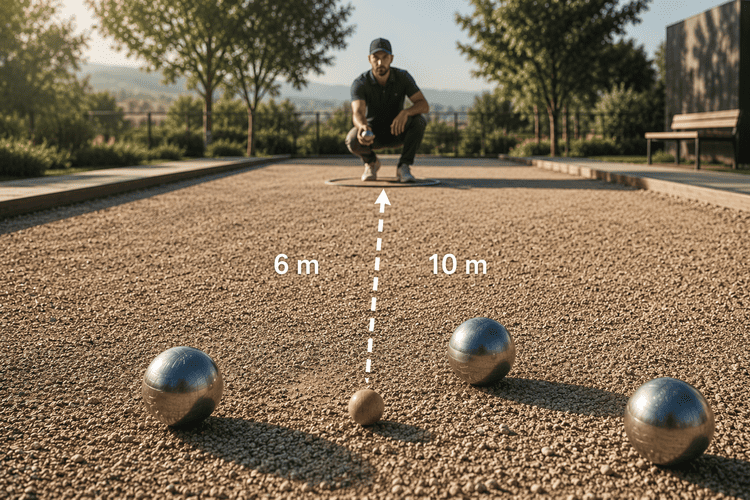
Every pétanque player knows this fundamental rule:
before starting an end, the jack must be thrown at a distance between 6 and 10 meters.
Today, this rule feels completely natural.
Yet very few players actually stop and ask themselves:
Why this specific distance?
Why not play at 3 meters, 15 meters, or even allow completely free distances?
Like many rules in pétanque, this choice was not made randomly.
It is the result of a long evolution combining the history of the game, sporting balance, and adaptation to different player styles.
Let’s take a closer look at why the jack must be thrown between 6 and 10 meters.
Originally, Distances Were Far Less Standardized
To understand this rule, we need to go back to the origins of boule games.
Long before the official birth of pétanque in 1907, several variations already existed in southern France.
Among them:
- Jeu Provençal
- La Longue
- Various regional boule games
At that time, distances varied enormously.
Each region often had its own habits and traditions.
Some games were played on very short courts.
Others used much longer distances.
There was no truly universal rule yet.
The Official Birth of Pétanque in 1907 Changed the Rules
When pétanque officially appeared in La Ciotat in 1907, the rules gradually began to become standardized.
The principle of the game changed significantly.
Unlike Jeu Provençal, where players took a running start, pétanque now required:
both feet to remain fixed inside a circle.
Players could no longer run before throwing.
This naturally changed the practical playing distances.
It became necessary to find a distance that was:
- long enough to make the game interesting
- but not too long to prevent players from playing without momentum
The first official rules gradually introduced more precise distance limits.
Why a Minimum of 6 Meters?
The 6-meter minimum prevents games from becoming too easy.
If the jack were placed only 2 or 3 meters away:
- pointing would become extremely easy
- shooting would become much easier
- the game would lose much of its challenge
The technical difficulty would drop significantly.
A game that is too easy leaves much less room for true player skill.
The 6-meter minimum therefore guarantees a first level of technical challenge.
Why a Maximum Limit of 10 Meters?
On the other hand, a distance that is too long creates different problems.
If games were played at 15 or 20 meters:
- some players would simply be unable to throw accurately at such distances
- matches would become physically demanding, especially during long competitions
It is important to remember that pétanque is meant to remain accessible to all player profiles.
The 10-meter maximum helps preserve this balance.
Even elderly players or beginners can theoretically play correctly at this distance.
A Distance That Allows Different Playing Styles
Depending on the chosen distance, strategy changes considerably.
At 6 Meters
The game often becomes:
- more precise
- more tactical
- more beginner-friendly
At 8 Meters
This is often considered the most versatile distance.
It allows:
- a good balance between pointing and shooting
- several different playing styles
- greater strategic depth
Many players consider this distance the most enjoyable to play.
At 10 Meters
The game becomes more demanding.
We often see:
- more difficult shooting because of the distance
- more difficult pointing, often requiring players to lob the boule more often
This distance generally favors experienced players because everything becomes more technical.
The Rule Sometimes Changes Depending on Categories
Although the general rule requires 6 to 10 meters, some competitions occasionally adapt the distances.
For example:
- youth competitions
- specific player categories
- recreational events
- certain local tournaments
For younger players, distances may sometimes be reduced to adapt the game to their physical abilities.
The goal always remains the same:
maintaining the balance of the game.
Terrain Also Greatly Influences Distance Choice
Not all pétanque courts are the same.
A player will rarely choose the same distance depending on the surface.
On a fast rolling terrain:
players can often choose longer distances.
On difficult or rocky terrain:
a shorter distance may be preferable.
Experienced players always analyze:
- terrain speed
- obstacles
- possible bad bounces
- favorable landing zones
Choosing the distance is an important part of overall strategy.
Why Not Allow Completely Free Distances?
One might imagine letting each team choose any distance they want.
However, this would create several problems.
Some teams could intentionally:
- choose extreme distances
- completely unbalance the game
- favor only their own playing style
A fixed rule helps guarantee:
- fairness
- competition consistency
- better international standardization
- greater interest in the game
This uniformity is essential in a sport played worldwide.
This Rule Is Now Applied Worldwide
Pétanque has expanded far beyond France.
Today, high-level pétanque is played in many countries including:
- Spain
- Belgium
- Thailand
- Madagascar
- Tunisia
- Netherlands
- Germany
- Canada
Everywhere, the rule remains the same:
the jack must be thrown between 6 and 10 meters.
This distance has now become part of the very identity of modern pétanque.
Conclusion
If the jack must be thrown between 6 and 10 meters, it is certainly not by accident.
This rule results from a carefully built balance developed throughout the evolution of the game.
It helps maintain:
- sufficient technical difficulty
- balance between pointing and shooting
- accessibility for all players
- consistency in official competitions
A rule that seems simple at first glance…
but directly contributes to the very essence of pétanque.
The next time you throw the jack, you’ll now know why these famous 6 to 10 meters have become a universal rule in the world of pétanque.

Are you organizing a tournament?
With Petanque Manager, run your pétanque tournaments effortlessly with automatic match draws, live results and real-time rankings.
Create an organizer profile