


Why are petanque boules hollow?
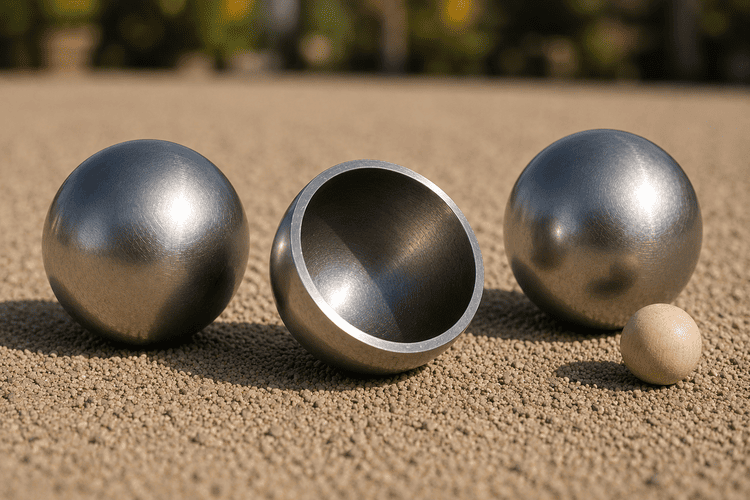
Why are petanque boules hollow?
Introduction
When playing pétanque, one detail seems completely obvious:
the boules are hollow.
Yet very few players actually stop and ask themselves:
Why aren’t pétanque boules solid?
Why do manufacturers systematically use hollow metal boules instead of a solid block of steel?
What seems completely natural today is actually the result of a long evolution combining the history of boule games, physical constraints, playing performance, and official regulations.
Let’s take a closer look at why pétanque boules became hollow and why this design remains essential today.
Originally, The First Boules Were Obviously Not Hollow
Long before the official birth of pétanque in 1907, boule games had already existed for several centuries.
At that time, players used very simple objects:
- Stones
- Pebbles
- Solid wooden balls
These early versions were naturally completely solid.
The problem was simple:
these materials quickly showed limitations in terms of durability, weight, and consistency.
As boule games gradually evolved, new materials began to appear.
The First Metal Boules Were Far Too Heavy
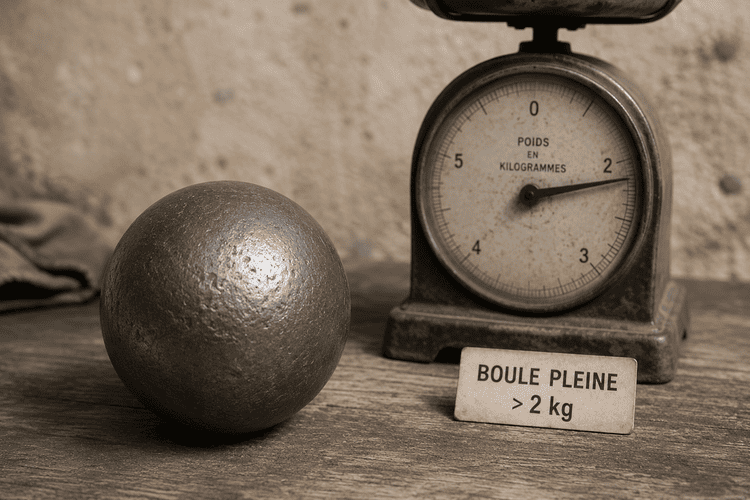
When manufacturers first began experimenting with metal in the early 20th century, a major issue immediately appeared.
A fully solid steel boule became extremely heavy.
To give an idea:
- A solid 74 mm steel boule would weigh well over 2 kilograms
- A competition boule today weighs between 650 g and 800 g
A solid boule would therefore be completely unplayable.
The player would lose:
- Precision
- Comfort
- Endurance
- Control
It quickly became obvious that the boule needed to be significantly lighter.
The Hollow Structure Allows The Ideal Weight
The solution quickly became obvious:
manufacture hollow spheres.
By using a metal shell with an empty interior, manufacturers immediately achieved a weight much better suited for the game.
Today, approved boules generally weigh between:
- 650 grams
- 800 grams
This range provides an excellent balance between:
- Power
- Precision
- Control
- Throwing comfort
Without a hollow structure, this balance would be impossible to achieve.
A Hollow Boule Absorbs Impact Better
In pétanque, impacts are constant.
Boules collide continuously:
- During shooting
- While pointing
- During carreaux
- During multiple collisions
A hollow structure allows better distribution of mechanical stress.
It helps to:
- Distribute impact energy more effectively
- Reduce certain deformations
- Improve overall durability
The boule therefore keeps its playing characteristics longer.
Modern Manufacturing Uses Two Welded Half-Shells
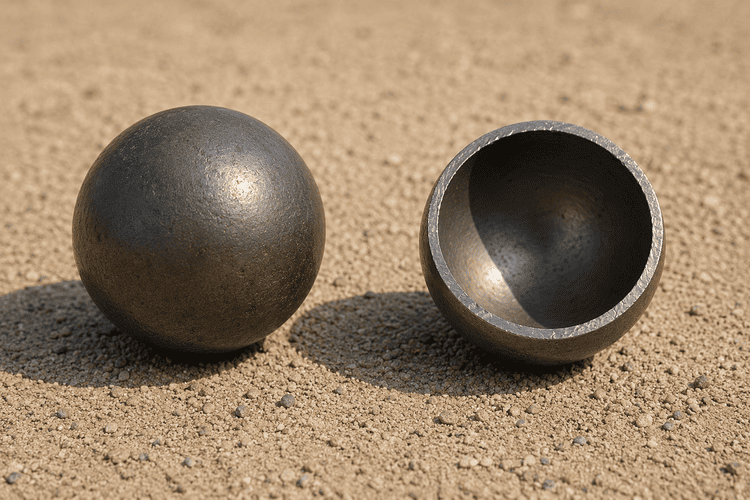
Today, manufacturers generally use a highly precise industrial process.
The production process involves several steps:
- Creating two steel half-spheres
- Joining both parts together
- Extremely precise welding
- Heat treatment
- Final machining
- Engraving and finishing
This method guarantees:
- Perfect balance
- A perfectly spherical shape
- Excellent durability
Some premium boules require extremely strict quality control.
The Hollow Structure Also Affects Boule Behavior
The fact that the boule is hollow directly influences how it behaves on the terrain.
A pétanque boule must provide:
- Good shock absorption during impacts
- Predictable behavior after shooting
- Consistent trajectory
- Reliable rolling behavior
A solid boule would behave differently.
It would transfer much more energy during collisions.
The overall dynamics of the game would be completely altered.
Official Rules Require Hollow Boules
Today, international regulations are very clear.
In official competitions, boules must be:
- Made of metal
- Hollow
- Approved by official federations
- Between 70.5 mm and 80 mm in diameter
- Between 650 g and 800 g in weight
These regulations guarantee perfect fairness between all players.
It is therefore impossible to use a solid boule in official competition.
Why Not Fill Boules With Other Materials?
One could imagine adding:
- Sand
- Lead
- An internal core
- Other composite materials
But this would immediately create several problems:
- Internal imbalance
- Irregular behavior
- Unfair advantage for certain players
- Difficulty standardizing equipment
A uniform hollow structure remains the most reliable solution today.
The Future Of Hollow Boules Continues To Evolve
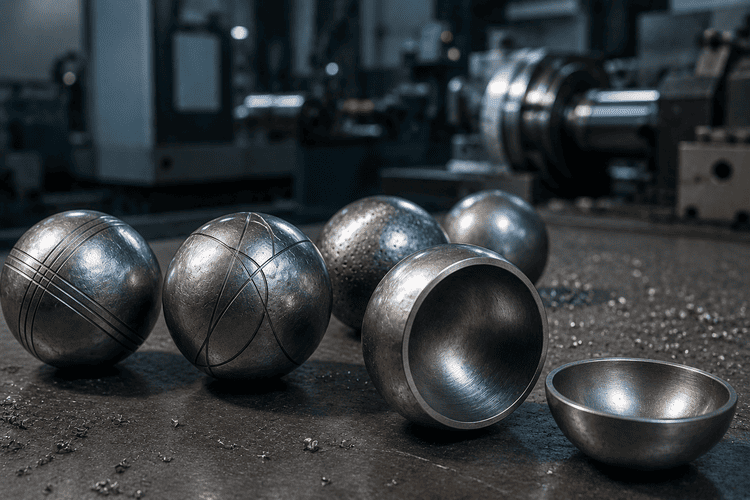
Even though the principle of the hollow boule has remained unchanged for many years, manufacturers continue to innovate.
Current research focuses on:
- New metal alloys
- Better wear resistance
- More advanced heat treatments
- Longer-lasting engravings
- Different hardness levels adapted to playing styles
However, the principle always remains the same:
a perfectly balanced hollow boule.
Conclusion
If pétanque boules are hollow today, it is certainly not by accident.
This design allows manufacturers to achieve the ideal weight, improve impact resistance, guarantee excellent precision, and comply with official competition regulations.
Without this hollow structure, modern pétanque as we know it today would probably not exist.
The next time you pick up your triplette, you’ll know that inside… there is nothing.
And yet, that empty space is one of the most important elements in the entire design of a pétanque boule.
Latest articles


Are you organizing a tournament?
With Petanque Manager, run your pétanque tournaments effortlessly with automatic match draws, live results and real-time rankings.
Create an organizer profile