


Why are pétanque boules made of metal? The surprising history behind it

Why are pétanque boules made of metal? The surprising history behind it
Introduction
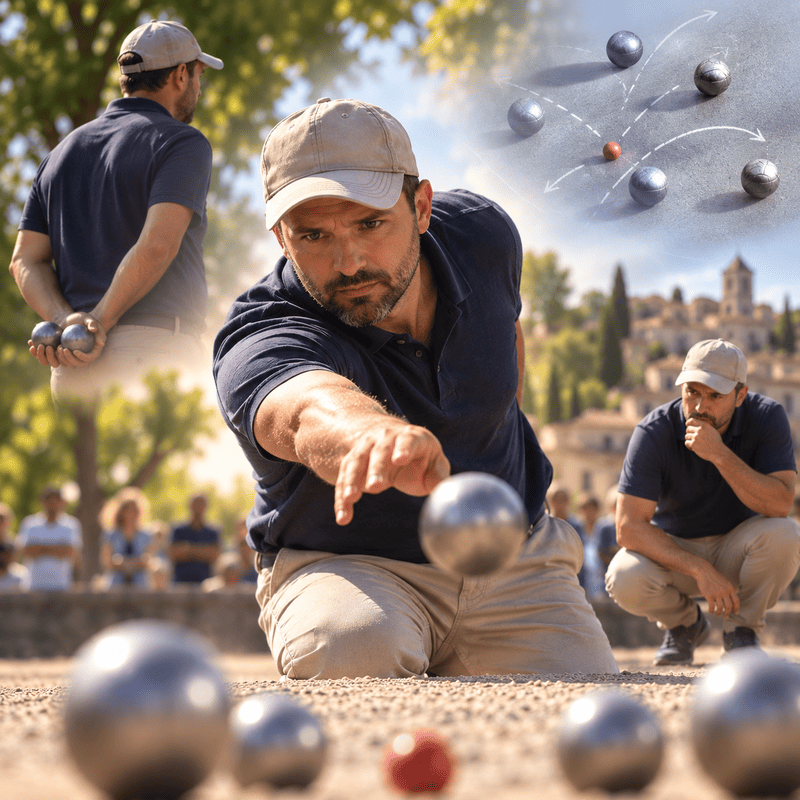
When we think about pétanque, one image immediately comes to mind:
players, a jack… and of course metal boules.
Today, this feels completely natural.
Yet very few players actually stop and ask themselves:
Why are pétanque boules made of metal?
Why don’t we use wood, plastic, or other lighter materials?
What seems obvious today is actually the result of a long historical evolution linked to ancient boule games, industrial progress, and the specific needs of the modern game.
Let’s discover why pétanque boules eventually became metallic.
Originally, Boule Games Were Played with Stone Balls
Long before modern pétanque was born, boule games had already existed for several thousand years.
We can find traces of similar games in:
- Ancient Egypt
- Ancient Greece
- The Roman Empire
At that time, players mainly used:
- Rounded stones
- Pebbles
- Naturally spherical objects
These early versions were obviously very primitive.
The objective was already simple:
throw an object as close as possible to a target.
Wood Was Used for a Long Time
Over time, boule games evolved.
During the Middle Ages and later the Renaissance, players began producing more regular-shaped balls.
The most commonly used material became:
wood.
For several centuries, boules were made from hard woods such as:
- Boxwood
- Oak
- Elm
Wood offered several advantages:
- Easy to shape
- Low cost
- Easily available
However, it also had several major drawbacks.
The Main Problem with Wood: Wear and Tear
Wooden boules deteriorate relatively quickly.
With repeated impacts:
- They crack
- They gradually deform
- They wear down quickly on hard surfaces
Another issue also appears:
Weight.
Wood remains relatively light.
This significantly changes the behavior of the boule.
Control becomes less precise, especially on uneven terrain.
As boule games became more popular, players began searching for a more durable solution.
The Arrival of Nail-Studded Boules
Before fully metallic boules, an intermediate solution appeared during the 19th century:
nail-studded boules.
The concept was simple.
A wooden core was kept, but the surface was covered with many small metal nails.
These boules became extremely popular in southern France.
They offered several advantages:
- Greater durability
- Better resistance to wear
- Increased weight
- Improved playing sensations
For a long time, they completely dominated traditional Provençal boule games.
Even today, some traditional competitions occasionally use reproductions of nail-studded boules.
The Industrial Revolution Changed Everything
At the beginning of the 20th century, metal manufacturing techniques improved dramatically.
Industry now allowed manufacturers to produce metal spheres with far greater precision.
It was during this period that pétanque officially appeared in 1907 in La Ciotat, France.
The game quickly became popular.
With growing popularity came the need to standardize equipment.
Manufacturers then started producing the first fully metallic boules.
A new era had begun.
Why Is Metal Ideal for Pétanque?
Metal offers many advantages that perfectly fit the requirements of the game.
Better Impact Resistance
In pétanque, impacts happen constantly.
Boules frequently collide with each other.
Metal allows boules to:
- Resist repeated collisions
- Limit excessive wear
- Maintain a perfectly spherical shape
This is a huge advantage compared to wood.
Better Weight Distribution
Modern boules generally weigh between:
- 650 grams
- 800 grams
Metal allows manufacturers to achieve this ideal weight.
This weight provides:
- Better stability
- Greater precision
- Better trajectory control
A heavier boule behaves in a much more predictable way.
Greater Precision
Metal allows extremely precise manufacturing.
Boules are perfectly balanced.
This guarantees:
- Better rolling behavior
- More consistent trajectories
- Greater consistency between each throw
This precision is essential in competition.
Much Longer Lifespan
A quality set of boules can last many years.
Metal resists far better against:
- Repeated impacts
- Surface abrasion
- Difficult terrains
Even after thousands of throws, a boule usually keeps its original characteristics.
Why Is Steel Used?
Today, most pétanque boules are made from steel.
Mainly:
- Carbon steel
- Stainless steel
Steel offers an excellent balance between:
- Strength
- Weight
- Manufacturing cost
- Ease of machining
It also allows manufacturers to offer different hardness levels depending on playing style.
Why Not Use Aluminum?
One could imagine using a lighter metal such as aluminum.
However, this creates several problems.
Aluminum:
- Is far too light
- Deforms more easily
- Absorbs impacts less effectively
The playing behavior would be completely different.
Precision would decrease significantly.
Why Not Use Plastic?
Plastic boules do exist.
They are mainly intended for:
- Children
- Beach games
- Casual recreational play
However, they are completely unsuitable for competition.
Plastic:
- Is too light
- Wears out quickly
- Offers poor precision
- Handles impacts poorly
It is impossible to achieve the playing sensations regular players are looking for.
Do Materials Affect Playing Style?
Absolutely.
Even among metallic boules, the material affects playing sensations.
Carbon Steel
Advantages:
- Better grip
- Softer feel in hand
- Highly appreciated by competitive players
Disadvantage:
- Sensitive to rust
Stainless Steel
Advantages:
- Corrosion resistant
- Minimal maintenance
- Long-lasting shiny appearance
Disadvantage:
- Can feel slightly slippery for some players
Bronze
Widely used in the past.
Advantages:
- Very durable
- Unique appearance
Today, bronze boules have become much rarer.
Do Official Rules Require Metal Boules?
Yes.
In official competitions, international regulations require several strict criteria.
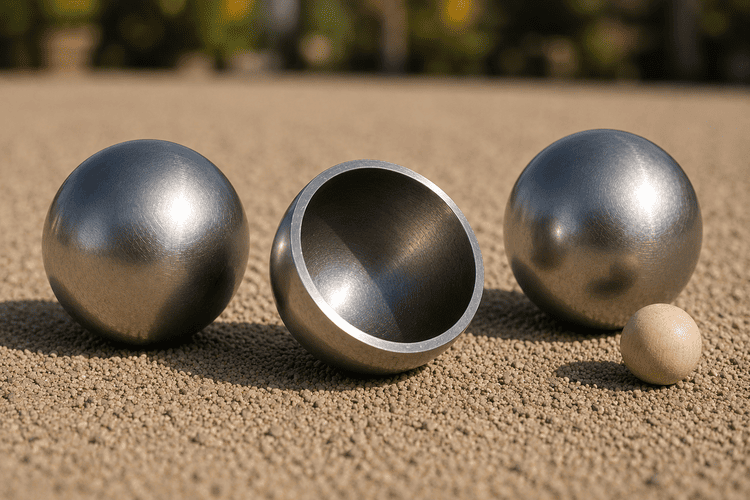
Boules must be:
- Made of metal
- Hollow
- Officially approved
- Between 70.5 mm and 80 mm in diameter
- Between 650 g and 800 g in weight
These rules guarantee fairness between all players.
Will Boules Continue to Evolve in the Future?
Technology continues to evolve.
Some manufacturers are already working on:
- New metal alloys
- Innovative surface treatments
- Better wear resistance
- More durable engravings
However, it is highly unlikely that pétanque will ever move away from metal.
Metal is now an integral part of the sport’s identity.
Conclusion
If pétanque boules are made of metal today, it is certainly not by accident.
After centuries of evolution moving from stone to wood and then to the famous nail-studded boules, metal eventually became the ideal material.
Strength, precision, balance, durability, and playing sensations:
no other material meets the demands of modern pétanque as effectively.
The next time you pick up your triplette, you’ll know it is the result of several centuries of evolution in boule games.
A simple metal object…
that has become one of the most iconic symbols of pétanque.



Are you organizing a tournament?
With Petanque Manager, run your pétanque tournaments effortlessly with automatic match draws, live results and real-time rankings.
Create an organizer profile