


Why is pétanque played to 13 points? the story behind one of the game’s most iconic rules
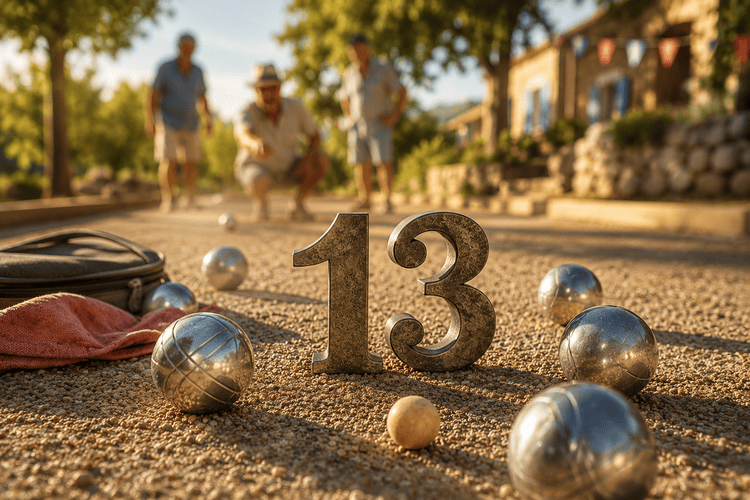
Why is pétanque played to 13 points? the story behind one of the game’s most iconic rules
Introduction
Every pétanque player knows this rule by heart:
a game is won at 13 points.
Whether playing casually with friends, in a local tournament, or during an official championship, this number feels completely natural.
Yet very few players actually stop and ask themselves:
Why do we play specifically to 13 points?
Why not 10 points, 15 points, or even 21 points like in other traditional sports?
This rule, which has become universal in the world of pétanque, actually has an interesting history combining tradition, game balance, and the gradual evolution of official competitions.
Let’s take a closer look at where this famous score of 13 points comes from.
Pétanque Was Officially Born in 1907
To understand the origin of 13 points, we need to go back to the official birth of pétanque.
Although boule games have existed since ancient times, modern pétanque officially appeared in 1907 in La Ciotat, in the south of France.
Legend says that a player named Jules Lenoir, who suffered from rheumatism, could no longer take the running start used in the traditional Provençal game.
His teammates then adapted the rules.
The player would now throw while keeping both feet fixed inside a circle drawn on the ground.
The word pétanque actually comes from the Provençal expression:
"Pès tanqués"
which means:
"Feet planted" or "feet firmly anchored to the ground."
At that time, the rules were still far from being fully standardized.
Before Pétanque, Other Boules Games Already Used Different Scores
Pétanque comes directly from the Jeu Provençal, which was already very popular in southern France.
In these traditional games, matches could be played:
- To 11 points
- To 13 points
- To 15 points
- Sometimes even to 21 points
There was no universal rule yet.
Each region often had its own traditions.
As pétanque started becoming more organized, it became necessary to standardize certain rules.
Naturally, the final score became part of those decisions.
Why 13 Points and Not 10 or 15?
The choice of 13 points does not seem to come from a specific decision or clearly documented historical event.
However, several practical and historical explanations exist.
The main reason concerns the balance of match duration.
A Match Long Enough to Allow Strategy
If a game were played to only 5 or 7 points, luck would play far too large a role.
A few well-played boules would be enough to finish a game very quickly.
On the other hand, a higher score such as 21 points would significantly increase match duration.
The choice of 13 points appears to be an ideal compromise.
It allows:
- Multiple ends
- Many comeback opportunities
- More strategic depth
- Better expression of players’ actual skill level
A team trailing 10–2 can still come back.
Suspense remains present until the very end.
The Number 13 Helps Reduce the Influence of Luck
In pétanque, the terrain has a huge impact on the game.
A bad bounce, a stone, or an uneven surface can completely change an end.
In a match that is too short, a single lucky shot could decide the winner.
By playing to 13 points, the number of ends is usually sufficient for skill, tactics, and consistency to prevail.
In a way, the 13-point format helps “correct” random elements of the game.
An Ideal Duration for Official Competitions
Another advantage of the 13-point format concerns tournament organization.
On average, a pétanque game lasts between:
- 35 minutes
- 1 hour 15 minutes
Of course, this depends on player level and terrain conditions.
Playing to 13 points allows organizers to better manage:
- Number of rounds
- Court rotation
- Overall tournament duration
- Final match scheduling
It has become an extremely practical format for competitive play.
Why Not Play to 15 Points?
Some people occasionally think that 15 points would seem more logical.
However, two additional points make a big difference.
Across hundreds of games during a large tournament:
- Total playing time increases significantly
- Delays become more frequent
- Finals can end very late
The 13-point format keeps games long enough while remaining manageable for tournament organization.
And Why Not 10 Points?
On the other hand, games played to 10 points would often be too short.
A single bad end worth 4 or 5 points could almost immediately eliminate a team.
Players would have less time to demonstrate their true level.
Matches would become more unpredictable.
The 13-point format better rewards consistency.
Does the Number 13 Have Any Special Meaning?
Some amusing theories occasionally circulate.
People sometimes say:
- 13 is considered lucky in certain regions
- 13 may come from old Provençal traditions
- Early clubs may have adopted the number out of cultural habit
In reality, no serious historical evidence confirms these theories.
The most credible explanation remains the sporting balance that naturally developed over time.
The 13-Point Rule Is Now Used Worldwide
Pétanque has grown considerably since its creation.
Today, it is played in dozens of countries, including:
- France
- Spain
- Belgium
- Thailand
- Madagascar
- Tunisia
- Sweden
- Netherlands
- Germany
- Canada
Everywhere, the rule remains the same:
An official game is played to 13 points.
This number has become a true international standard.
Some Competitions Occasionally Use Other Formats
Although 13 points remains the standard, some competitions sometimes adapt the rules.
For example:
- Games played to 11 points for fast tournaments
- Time limits in championships
- Shortened formats for special events or entertainment competitions
This allows organizers to speed up tournament progression when necessary.
However, in the minds of most players, real pétanque remains strongly associated with 13 points.
Conclusion
The famous 13-point score was not chosen randomly.
Inherited from the history of traditional Provençal boules games, it now represents an almost perfect balance between game duration, strategy, suspense, and tournament organization.
Long enough to allow players’ talent to shine, yet short enough to allow multiple games during a competition, this format gradually became the worldwide standard.
Now you finally know the hidden story behind one of the most iconic rules in pétanque.

Are you organizing a tournament?
With Petanque Manager, run your pétanque tournaments effortlessly with automatic match draws, live results and real-time rankings.
Create an organizer profile