


Should you shoot or point? How to make the right decision ?
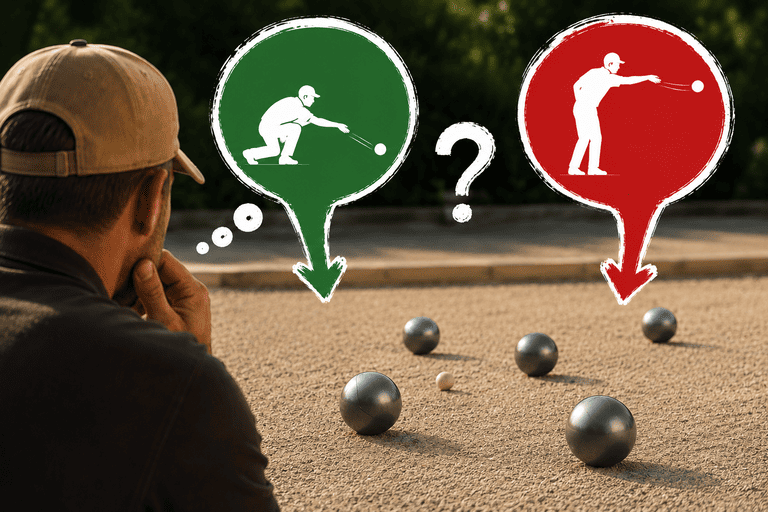
Should you shoot or point? How to make the right decision ?
Shooting or pointing: a decision that can change an entire end
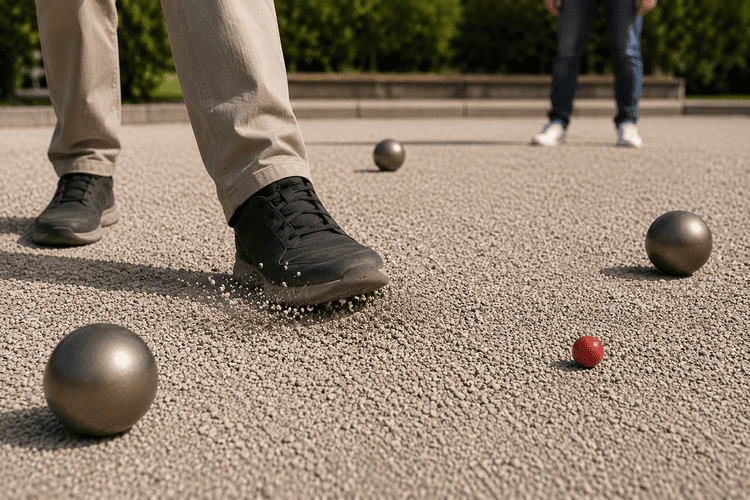
In pétanque, being able to throw your boule accurately is essential. But even before playing, another question arises: should you point or shoot?
When the game is close and the last boules are in play, this decision becomes even more important. A well-placed boule can allow you to take the point, while a successful shot can completely change the situation.
But under pressure, the choice is not always obvious. You have to consider the position of the boules, how many boules are still available, the score and sometimes even the condition of the terrain.
So, how do you know whether it is better to shoot or point?

Start by analysing the situation
Before playing, it is important to take a few seconds to carefully observe the end. A decision made too quickly can turn a favourable situation into a difficult one.
Several factors need to be taken into account:
- the position of your boule in relation to the jack;
- the position of the opponent's boules;
- the number of boules remaining for each team;
- the score of the game;
- the distance of the jack;
- the quality of the terrain;
- your level of confidence in shooting or pointing.
You should therefore not simply ask yourself: "Can I shoot?" but rather: "Which action gives my team the best chance of winning this end?"
When should you favour pointing?
Pointing is generally the most logical choice when you can place a boule in a favourable area without taking an excessive risk.
For example, if your team already has a boule close to the jack and the opponents have only one boule left, there may be little point in attempting a difficult shot.
In this situation, adding a second well-placed boule can force the opponents to play an excellent shot to regain the advantage.
Pointing can also be the better option when:
- the opponent's shot would be particularly difficult;
- you have several boules left to play;
- the terrain makes pointing relatively easy;
- the risk of missing a shot is greater than the potential benefit;
- you are in a favourable position on the scoreboard and want to limit the risks.
When should you attempt a shot?
Conversely, shooting often becomes interesting when an opponent's boule is particularly well placed and prevents you from winning the end.
If an opponent's boule is just a few centimetres from the jack and it is difficult to do better by pointing, shooting may become the best option.
Shooting can be particularly relevant when:
- an opponent's boule is very close to the jack;
- several opposing boules are grouped together;
- you absolutely need to regain the point;
- pointing carries a significant risk of losing several points;
- you have enough technical ability to make the shot successfully.
But be careful: shooting is not necessarily the more attacking solution. In some situations, a missed shot can give the opponents an even greater advantage.
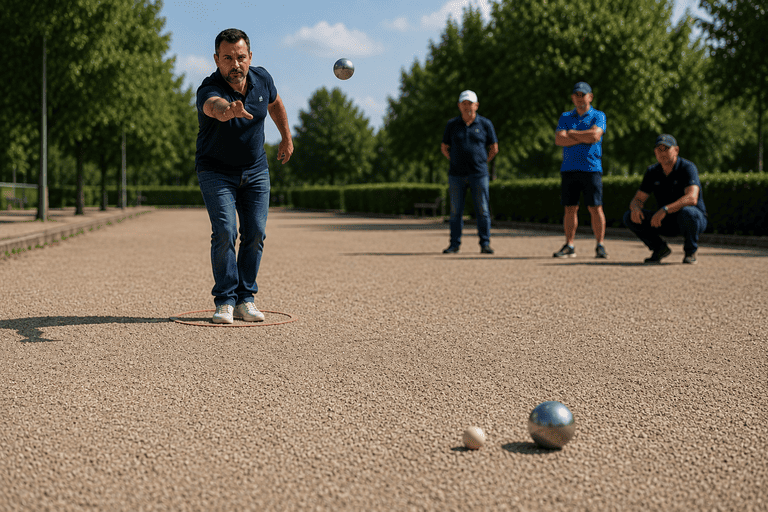
The number of boules remaining changes everything
One of the most common mistakes is to look only at the position of the boules without considering how many boules are still available.
Yet this information can completely change the decision.
Imagine that your team has two boules left while the opponents have only one. If you are already ahead on points, you are in a comfortable position.
Conversely, if the opponents still have three boules and your team has only one left, taking greater risks may sometimes be necessary to avoid losing several points.
The right decision therefore depends as much on what may happen next as on the current situation.
The score also influences the decision
At 2-2, the strategy is not necessarily the same as at 11-12.
When the game is approaching 13 points, every decision can have major consequences. Losing an end by several points can allow the opponents to finish the game immediately.
In some situations, it may therefore be preferable to play more cautiously.
Conversely, a team that is well behind on the scoreboard may have to take greater risks in order to try to come back into the game.
There is therefore no universal rule saying that you should always point or always shoot. The strategy must adapt to the score.
The terrain must also be taken into account
The decision also depends on the terrain.
On a very fast terrain, pointing can be difficult to control. On terrain with obstacles or irregularities, certain trajectories can become unpredictable.
Shooting can also be more or less risky depending on the nature of the playing surface.
An experienced player gradually learns the characteristics of the terrain and adapts their choice accordingly.
This is one of the reasons why it is important to take the time to observe the first few ends before establishing a real strategy.
Do not confuse taking a risk with rushing your decision
Under pressure, players can sometimes be tempted to immediately attempt a spectacular shot.
Yet a good strategic decision is not necessarily the most impressive one.
A perfectly controlled point can sometimes be much more effective than a difficult shot attempted simply because the situation feels tense.
Before playing, simply ask yourself three questions:
- What is the best result I can achieve by pointing?
- What is the best result I can achieve by shooting?
- What happens if I miss?
This last question is particularly important. You should always consider the cost of failure before choosing a risky option.
Pressure can affect your judgement
In pétanque, the difficulty is not only technical. In a decisive situation, pressure can change the way we perceive risk.
A shot that you make easily in training can seem much more difficult at 12-12 in competition.
Conversely, the fear of missing can push a player to systematically choose pointing when a shot would objectively be the better solution.
To avoid this, try to return to a simple and objective analysis of the situation.
Do not choose your shot simply because you are afraid of missing. Choose the option that gives your team the best chance of winning the end.
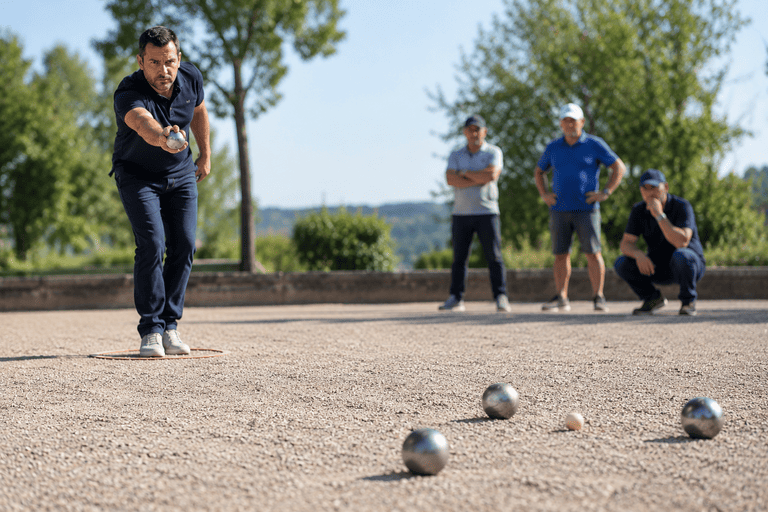
Shooting or pointing: a practical example
Imagine an end at 11-11.
The opponents have a boule approximately 20 centimetres from the jack. Your team still has two boules to play.
You then have several options.
You can try to point in an attempt to beat the opponent's boule. But if the terrain is difficult and the area around the jack is crowded, your boule could also stop behind or fail to take the point.
You can also attempt a shot to remove the opponent's boule and make the situation much more favourable.
The right choice will depend in particular on your ability to shoot, the difficulty of the terrain and the number of boules remaining.
Do not look for an automatic answer: compare the different scenarios.
The best decision is not always the most obvious one
The best players do not necessarily take more risks. Above all, they know when a risk is justified.
Pointing when a shot is unnecessary can be an excellent decision. Conversely, shooting when pointing offers almost no chance of winning can also be the most sensible choice.
With experience, this analysis gradually becomes faster.
A simple rule to remember
When you are hesitating between shooting and pointing, try to remember this rule:
point when you can improve the situation sufficiently with a reasonable level of risk; shoot when the opponent's boule is genuinely preventing you from winning the end or when pointing has become too risky.
And above all, take the whole situation into account: score, boules remaining, terrain, position of the boules and level of risk.
Conclusion
In pétanque, shooting or pointing is not simply a question of technique. It is above all a strategic decision.
The further the game progresses, the more important each decision can become. Being able to quickly analyse the situation, assess the risk of failure and choose the most appropriate shot allows you to make better decisions, even under pressure.
With experience, this thought process becomes almost automatic. And sometimes, the best shot is not the most spectacular one: it is simply the one that gives your team the best chance of winning the end.

Are you organizing a tournament?
With Petanque Manager, run your pétanque tournaments effortlessly with automatic match draws, live results and real-time rankings.
Create an organizer profile