


How to Create an Internal Ranking System for Pétanque Club Players?
How to Create an Internal Ranking System for Pétanque Club Players?
How to Create an Internal Ranking System for Pétanque Club Players?
In many pétanque clubs, the same question often comes up:
How can you compare players' performances throughout the year in a simple and fair way?
An internal ranking system provides the answer by tracking players' results across the various tournaments organized by the club.
In addition to adding a fun and competitive element, an internal ranking motivates players to participate regularly in club activities and allows them to monitor their progress throughout the season.
With Petanque Manager, it is easy to create and maintain an internal ranking based on à la mêlée tournaments, automatically updated after each competition.
What Is an Internal Club Ranking?
An internal ranking is a leaderboard reserved exclusively for members of the same club.
Unlike official federation competitions, its primary objective is not to determine the best regional or national player, but rather to measure the consistency and performance of club members throughout the season.
This ranking can be used to:
- Reward the most consistent players
- Increase club activity and engagement
- Encourage participation in internal tournaments
- Organize annual club challenges
- Assist with player selection for official competitions
It is also an excellent way to create a friendly atmosphere while adding a sporting challenge to club events.
Why Use À La Mêlée Tournaments?
To build a reliable individual ranking, it is important to minimize the influence of regular teammates.
This is precisely why à la mêlée tournaments are particularly suitable.
In an à la mêlée competition, teams are randomly drawn before each match.
Players regularly change partners and face different opponents throughout the tournament.
This approach offers several advantages:
- Greater fairness among participants
- Reduced impact of teammate skill level
- More interactions between club members
- A better representation of individual ability
The resulting ranking reflects personal performance much more accurately than tournaments based on fixed teams.
How Does the Ranking Work?
The principle is simple.
During each à la mêlée tournament organized by the club, every player accumulates:
- Wins
- Points scored
- Points conceded
At the end of the tournament, an individual ranking is calculated.
Throughout the season, the results of all tournaments are combined to produce the club's overall ranking.
Number of Wins: The Primary Ranking Criterion
The main criterion used to rank players is the total number of wins.
Every match won helps improve a player's position in the ranking.
For example:
| Player | Wins |
|---|---|
| Peter | 18 |
| John | 16 |
| Mark | 15 |
In this example, Peter is ranked ahead of John and Mark because he has won more matches.
This system primarily rewards consistency and the ability to win games.
Point Differential: The Secondary Tie-Breaker
When multiple players have the same number of wins, a second criterion is used.
This criterion is the point differential, calculated as follows:
Point Differential = Points Scored − Points Conceded
This system rewards players who win their matches by significant margins while limiting the points scored against them.
For example:
| Player | Wins | Points Scored | Points Conceded | Point Differential |
|---|---|---|---|---|
| Peter | 12 | 156 | 102 | +54 |
| John | 12 | 148 | 103 | +45 |
| Mark | 12 | 152 | 117 | +35 |
All three players have the same number of wins.
The ranking is therefore determined by the point differential.
Peter takes first place ahead of John and Mark.
This method is particularly popular because it rewards not only victories but also the overall quality of a player's performances.
A Practical Example of an Internal Ranking
Imagine a club that organizes an à la mêlée tournament every Friday evening.
After several weeks, the ranking might look like this:
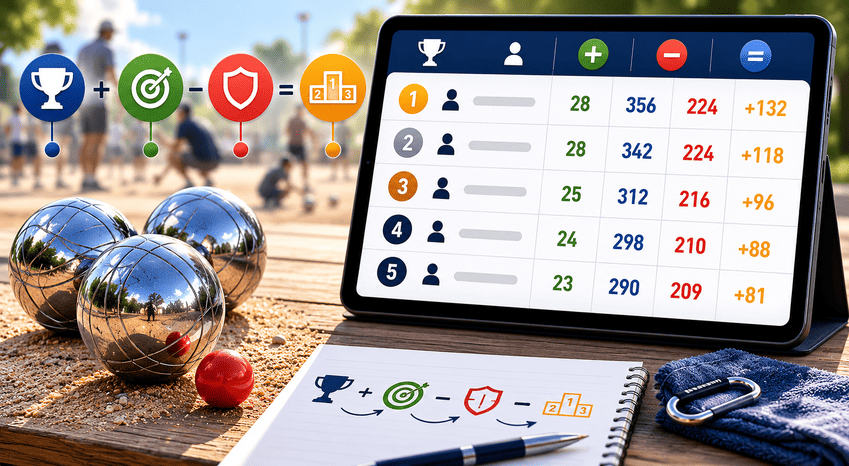
| Rank | Player | Wins | Point Differential |
|---|---|---|---|
| 1 | Peter Martin | 28 | +132 |
| 2 | John Bernard | 28 | +118 |
| 3 | Mark Dupont | 25 | +96 |
| 4 | Alan Robert | 24 | +88 |
| 5 | Nicolas Petit | 23 | +81 |
Even though Peter and John have the same number of wins, Peter ranks higher thanks to his superior point differential.
The ranking therefore rewards both consistency and overall performance.
Why Is This System Fairer?
In some clubs, internal rankings are based solely on the number of wins.
The problem is that two players may achieve the same number of victories while delivering very different overall performances.
The point differential provides a more accurate way to separate players.
A player who consistently wins by comfortable margins will naturally be rewarded compared to someone who wins narrowly or suffers several heavy defeats.
As a result, the ranking becomes a much better reflection of each player's true level.
Benefits for the Club
Increased Participation
Players have an additional objective during every tournament.
They are often more motivated to participate regularly.
Better Club Atmosphere
The ranking creates friendly rivalries among club members.
Discussions about ranking positions quickly become a popular topic within the club.
Performance Tracking
Club managers can monitor player progress throughout the season.
They gain a clear overview of each member's results and development.
Ongoing Club Activity
Even outside official competitions, the ranking helps maintain a strong sporting dynamic within the club.
How Can You Manage an Internal Ranking Easily?
Managing an internal ranking manually can quickly become complicated.
- Keep track of tournament history
- Count victories
- Calculate points scored
- Calculate points conceded
- Recalculate point differentials
- Update rankings
- Avoid calculation errors
With Petanque Manager, all these operations are automated.
Every result entered during an à la mêlée tournament is immediately taken into account in the club's overall ranking.
Players can view their position in real time from their smartphone, tablet, or computer.
Why Use Petanque Manager for Your Internal Ranking?
Petanque Manager was designed to simplify the life of pétanque clubs.
- Organize à la mêlée tournaments
- Automatically generate draws
- Track results live
- Calculate individual rankings
- Maintain a complete tournament history
- View player statistics
Everything is centralized in a single tool accessible from any device.
Conclusion
Creating an internal ranking is one of the best ways to bring life and motivation to a pétanque club.
By using à la mêlée tournaments, it becomes possible to evaluate individual performances in a fair and balanced manner.
The ranking is based first on the number of victories and then on point differential, calculated from the difference between points scored and points conceded.
This method rewards consistency, efficiency, and overall performance throughout the season.
With Petanque Manager, managing an internal club ranking becomes simple, automatic, and accessible to every member of the club.



Are you organizing a tournament?
With Petanque Manager, run your pétanque tournaments effortlessly with automatic match draws, live results and real-time rankings.
Create an organizer profile