


How to choose your pétanque boules? the complete guide (weight, diameter, material, grooves and price)
How to choose your pétanque boules? the complete guide (weight, diameter, material, grooves and price)
Introduction
Choosing your pétanque boules is an important step for every player, whether you are a beginner, an occasional player, or an experienced competitor.
With so many models available on the market, it can be difficult to determine which boules truly suit your game.
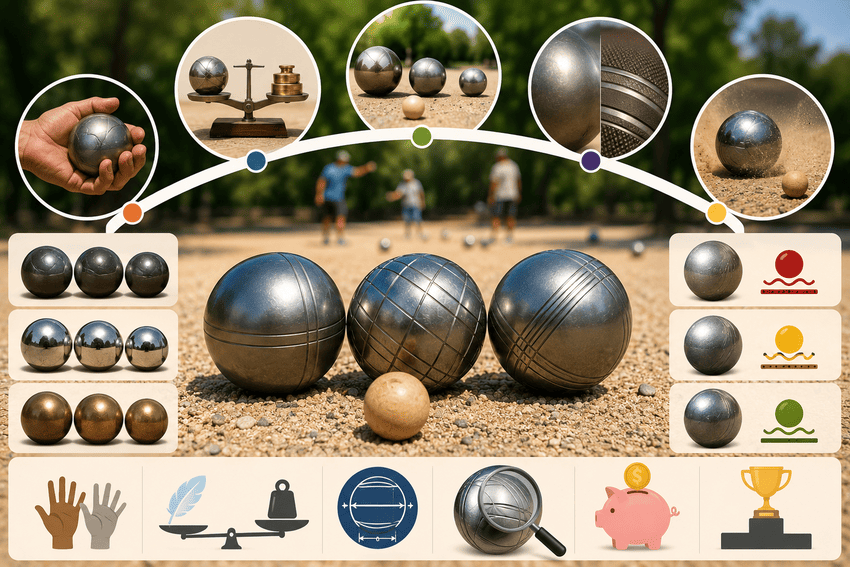
Weight, diameter, material, hardness, grooves, engravings, and budget are all factors that should be considered before making a choice.
Contrary to popular belief, there is no perfect boule for everyone.
The best boules are those that match your hand size, playing sensations, and playing style.
This guide will help you choose the pétanque boules that best fit your needs.
Why Choosing the Right Boules Matters
Boules are the most important piece of equipment for a pétanque player.
A poorly chosen set can quickly become uncomfortable and negatively affect performance.
Boules that are too heavy may tire your arm.
Boules that are too light may lack control.
An unsuitable diameter can make the boule difficult to hold.
Choosing the right boules can help you:
- Improve your playing sensations.
- Increase pointing accuracy.
- Improve shooting consistency.
- Reduce fatigue.
- Build confidence.
Choosing the Right Diameter
Diameter is one of the most important criteria.
Competition-approved boules generally range from 71 mm to 80 mm in diameter.
How to Choose Your Diameter
The diameter mainly depends on:
- Hand size.
- Finger length.
- Personal preference.
As a general guide:
- Small hands: 71 to 73 mm.
- Medium hands: 73 to 75 mm.
- Large hands: 75 to 78 mm.
A diameter that is too large may make the boule difficult to grip.
A diameter that is too small may create discomfort when releasing the boule.
The best solution is always to try several diameters before purchasing.
Choosing the Right Weight
Weight directly influences the behavior of the boule and the player's sensations.
Competition-approved boules generally weigh between 650 g and 800 g.
Lightweight Boules
The most commonly used weights are:
- 680 g
- 690 g
- 700 g
They are often preferred by shooters because they:
- Require less effort.
- Allow greater arm speed.
- Reduce fatigue during long playing days.
Heavy Boules
The most commonly used weights are:
- 710 g
- 720 g
- 730 g
- 740 g
They are often favored by pointers because they:
- Roll less.
- Stop more easily.
- Provide greater control.
Is There an Ideal Weight?
No.
The ideal weight depends on the player, their position, and their personal preferences.
Today, most competitive players use boules weighing between 680 g and 720 g.
Smooth or Grooved Boules?
Choosing between smooth and grooved boules is often a matter of personal preference.
Smooth Boules
They offer:
- A very consistent release.
- Easier cleaning.
- More even wear over time.
They are particularly appreciated by many shooters.
Grooved Boules
Grooves provide:
- Better grip.
- Easier identification on the terrain.
- Reassuring sensations for some players.
They are often chosen by pointers or players looking for additional grip.
Which Option Should You Choose?
There is no universal rule.
Many champions play with smooth boules, while others prefer heavily grooved models.
The choice mainly comes down to personal feeling.
Carbon Steel, Stainless Steel or Bronze?
The manufacturing material strongly influences the boule's behavior, maintenance requirements, and price.
Carbon Steel Boules
Carbon steel boules are very popular among pétanque players.
Main advantages:
- Excellent grip.
- Soft feeling in the hand.
- Highly appreciated by competitive players.
- Generally more affordable.
Disadvantage:
- They rust if not maintained regularly.
Stainless Steel Boules
Stainless steel boules are now widely used.
Advantages:
- Highly resistant to corrosion.
- Minimal maintenance.
- Long-lasting shiny appearance.
- Often greater durability.
Disadvantages:
- Can feel more slippery for some players.
- Generally more expensive than carbon steel models.
With similar specifications, a stainless steel set often costs several dozen euros more than a carbon steel set.
Bronze Boules
Much rarer today, bronze boules were widely used in the past.
They offer:
- Excellent wear resistance.
- A unique appearance.
However, they are now far less common on the modern market.
Which Hardness Should You Choose?
Hardness affects shock absorption.
Soft Boules
They absorb impacts more effectively.
Advantages:
- Highly appreciated by shooters.
- Reduced rebound after impact.
Disadvantage:
- Faster wear.
Semi-Soft Boules
Often considered the best compromise.
They offer:
- Good durability.
- Pleasant playing sensations.
- Excellent versatility.
Hard Boules
Advantages:
- Very resistant.
- Long lifespan.
Disadvantage:
- Greater rebound after impacts.
Are Engravings Important?
Contrary to what some players believe, engravings are not only for personalization.
They allow you to:
- Easily identify your boules.
- Avoid confusion with other players' boules.
- Personalize your equipment.
They also play an important regulatory role.
To remain approved for official competition, a boule must keep its mandatory markings visible:
- Manufacturer's brand.
- Identification number.
- Weight marking.
Over the years, repeated impacts can gradually wear away these engravings.
When the markings become unreadable, the boule may no longer be considered compliant for official competitions.
For this reason, many experienced players prefer models with deep engravings.
The deeper the original engravings, the longer they will remain visible despite natural wear.
Which Brand Should You Choose?
Several manufacturers produce excellent competition-approved boules.
Among the most well-known brands are:
- Obut
- La Boule Bleue
- MS Pétanque
- Boulenciel
- Toro Pétanque
Each brand has its own characteristics.
The most important factor is choosing a model that suits your game rather than focusing solely on the manufacturer.
What Budget Should You Plan?
Prices vary significantly depending on quality and materials.
Entry-Level
Between €30 and €70.
Suitable for:
- Beginners.
- Occasional players.
Mid-Range
Between €70 and €150.
Often the best balance between quality and price.
Premium Range
Between €150 and €350.
Designed for:
- Regular competitors.
- Players seeking very specific characteristics.
A higher price does not automatically guarantee better performance.
Should You Use the Same Boules as Champions?
Many beginners want to buy the same boules used by top players.
However, this is not always the best choice.
A high-level shooter may use very soft, lightweight, and technical boules that may not suit an occasional player.
Likewise, an experienced pointer may choose a specific diameter or weight that does not match your hand size.
Champions select their boules according to their playing style, experience, and personal preferences.
For most players, comfort, sensations, and compatibility with their own game should take priority over copying professional equipment.
Which Boules Suit Your Player Profile?
Beginner
- Stainless steel.
- Semi-soft.
- Medium weight.
- Reasonable budget.
Pointer
- Heavier weight.
- Diameter adapted to hand size.
- Often grooved.
Shooter
- Lighter weight.
- Soft or semi-soft boule.
- Often smooth.
All-Round Player
- Semi-soft.
- Medium weight.
- Choice based primarily on feel.
Conclusion
Choosing your pétanque boules is not simply a matter of selecting a brand or buying the same model used by a champion.
Diameter, weight, material, hardness, and personal sensations are the most important factors.
Taking the time to try different models is often the best way to find the perfect set.
Once you find the right boules, they can accompany you for many years and greatly contribute to both your enjoyment of the game and your performance on the terrain.


Are you organizing a tournament?
With Petanque Manager, run your pétanque tournaments effortlessly with automatic match draws, live results and real-time rankings.
Create an organizer profile