


How to Choose the Best Pétanque Tournament Format Based on the Number of Teams ?
How to Choose the Best Pétanque Tournament Format Based on the Number of Teams ?
How to Choose the Best Pétanque Tournament Format Based on the Number of Teams
Organizing a pétanque tournament is not simply a matter of registering teams and drawing matches. Choosing the right competition format is essential to ensure an enjoyable, balanced, and well-structured event that matches the number of participants.
A poorly chosen format can lead to long waiting times, unbalanced matches, or a competition that ends too quickly for some teams.
On the other hand, selecting the right format helps maximize player enjoyment while making the organizer's job much easier.
So, how do you choose the best tournament format based on the number of registered teams? Here's our complete guide.
Why Is the Number of Teams So Important?
Not all tournament formats are designed to accommodate the same number of participants.
Some formats work perfectly with a dozen teams, while others become truly effective only when twenty, thirty, or more teams are involved.
Before choosing a format, you should consider:
- The expected number of teams
- The available time
- The number of courts available
- The players' skill level
- The goal of the event (friendly or competitive)
A good format is, above all, a format that fits the reality of your tournament.
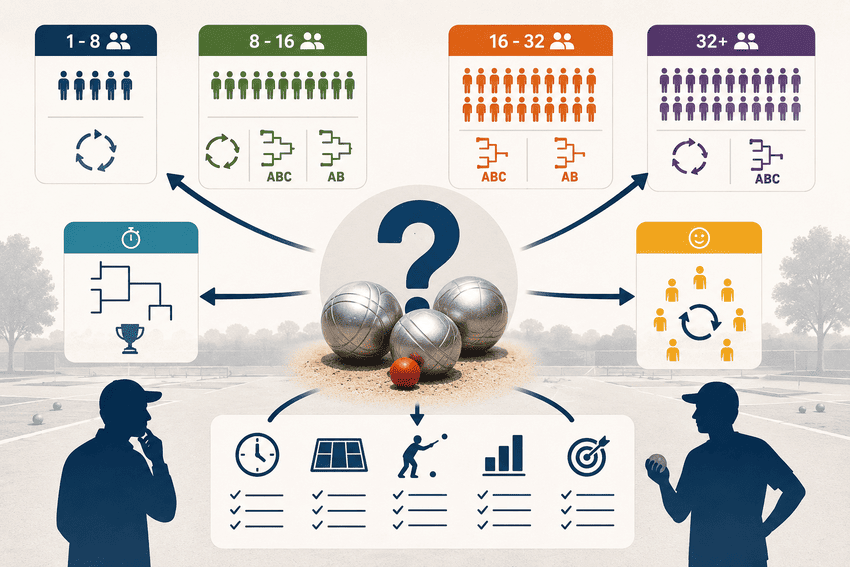
Fewer Than 8 Teams: Prioritize Multiple Matches
When only a few teams are registered, single-elimination formats are rarely the best option.
If you have only 6 or 8 teams and choose a knockout format, some teams will be eliminated after a single match.
This often leads to frustration.
In this situation, the best options are:
- Standard X-round tournaments
- Swiss System tournaments (winner vs winner)
- À la mêlée formats
These formats allow every team to play several matches.
They also create a better atmosphere since no one spends long periods waiting on the sidelines.
8 to 16 Teams: The Most Versatile Formats
This range corresponds to the majority of club tournaments.
Several formats work extremely well:
- Standard X-round tournaments
- Swiss System tournaments
- ABC format
- AB format
The Swiss System is particularly interesting.
However, it is important to understand that it is still fundamentally an X-round tournament.
The organizer decides in advance how many rounds will be played:
- 3 rounds
- 4 rounds
- 5 rounds
Every team will play exactly that number of matches.
The difference lies in how pairings are generated.
After each round, a ranking is calculated based on:
- Number of wins
- Point differential
Teams are then grouped according to their results.
Winning teams face other winning teams.
Teams that lost play against teams that also lost.
As the tournament progresses, matches become increasingly balanced.
For a more casual event, a standard X-round tournament remains an excellent choice.
16 to 32 Teams: Structured Competition Formats
As the number of teams grows, it becomes increasingly important to use a format capable of producing a reliable ranking.
The most suitable options are:
- Swiss System tournaments
- ABC format
- AB format
With 24 or 32 teams, the Swiss System truly shines.
After each round:
- A ranking is calculated
- Teams are grouped according to their results
- New pairings are generated automatically
Teams with the same number of wins are matched together whenever possible.
Likewise, teams with the same number of losses will generally face one another.
This approach quickly identifies the strongest teams while guaranteeing multiple matches for every participant.
More Than 32 Teams: Swiss System or Group Formats
When a tournament attracts dozens of teams, management becomes more challenging.
Organizers must:
- Reduce waiting times
- Optimize court usage
- Produce a fair and reliable ranking
In this context, two solutions stand out:
- Swiss System tournaments
- ABC or AB formats
The Swiss System is often the easiest format to manage using software such as Petanque Manager.
Each round is generated automatically.
Rankings are updated in real time.
Teams never face the same opponent twice.
Most importantly, every team continues playing until the end of the tournament.
When Should You Choose a Knockout Format?
Single-elimination tournaments remain very popular.
They are ideal when:
- Time is limited
- A large number of teams are participating
- You want to determine a winner quickly
Their main drawback is obvious:
One loss usually means the end of the tournament.
Some teams may travel long distances only to play a single match.
For this reason, knockout formats are generally reserved for final stages or official competitions.
When Should You Choose the ABC Format?
The ABC format is highly appreciated in pétanque tournaments.
After an initial qualification stage, teams are divided into different brackets according to their results.
This format offers several advantages:
- Multiple guaranteed matches
- Balanced competition levels
- Attractive final stages
It is particularly well suited to medium-sized tournaments.
When Should You Choose the AB Format?
The AB format follows the same principle as the ABC format but uses only two brackets.
It is often chosen when the number of teams is smaller or when the available time is limited.
It provides an excellent balance between competitiveness and friendliness.
When Should You Choose an À La Mêlée Format?
An à la mêlée format is ideal for:
- Training sessions
- Open days
- Club entertainment events
Teams change regularly.
Players meet as many different participants as possible.
The focus is more on enjoyment and social interaction than on competition.
Quick Summary
1 to 8 Teams
- Standard X-round tournament
- Swiss System tournament
- À la mêlée format
8 to 16 Teams
- Standard X-round tournament
- Swiss System tournament
- ABC format
- AB format
16 to 32 Teams
- Swiss System tournament
- ABC format
- AB format
More Than 32 Teams
- Swiss System tournament
- ABC format
Limited Time Available
- Single elimination
Friendly Atmosphere
- À la mêlée format
- Standard X-round tournament
Competitive Event
- Swiss System tournament
- ABC format
- AB format
Why Use Petanque Manager?
Choosing a tournament format is one thing.
Managing it correctly is another.
Petanque Manager makes it easy to organize:
- Standard X-round tournaments
- Swiss System tournaments
- ABC tournaments
- AB tournaments
- Single-elimination tournaments
- À la mêlée tournaments
The platform automatically handles:
- Match pairings
- Rankings
- Court assignments
- Results
- Statistics
Players can view results directly from their smartphones.
Organizers save a tremendous amount of time.
Conclusion
There is no perfect format for every pétanque tournament.
The best choice always depends on:
- The number of teams
- The available time
- The players' level
- The organizer's objectives
For smaller tournaments, X-round formats and à la mêlée events are often the most enjoyable.
For larger and more competitive events, Swiss System tournaments, ABC formats, and AB formats provide reliable rankings while guaranteeing multiple matches for every team.
Today, the Swiss System is one of the most popular winner-versus-winner formats used in modern pétanque competitions.
With Petanque Manager, you can manage all of these formats easily, without manual calculations and without the risk of errors.




Are you organizing a tournament?
With Petanque Manager, run your pétanque tournaments effortlessly with automatic match draws, live results and real-time rankings.
Create an organizer profile