


Organize a pétanque tournament using AB format
The AB format is one of the most commonly used formats in pétanque tournaments, especially official ones. It allows all teams to play several games while gradually separating them into two tournaments of different levels: Tournament A and Tournament B.
📌 What is a AB format tournament ?
The AB tournament begins with a group stage of 4 teams. Each team plays at least 2 games. Depending on the results, some teams qualify directly while others play a play-off to access Tournament A or Tournament B.
- Group of 4 teams
- Each team plays at least 2 matches during this phase.
- Play-off match to decide between the two teams that each won 1 match out of 2
- Allocation into two tournaments: A and B
📣 Promote your tournament!
To attract as many players as possible, consider publishing your tournament on specialized platforms such as the website petanque-generation.fr or petanque-world.com or the application Bouliste+ .
You can publish your tournament here in less than a minute: Add a petanque tournament
Publishing your tournament online significantly increases participation and contributes to the success of your event, both in terms of visibility and benefits for the club.
🔄 Team allocation (Tournament A and Tournament B)
After the first 2 group matches:
- 2 wins → direct qualification for Tournament A
- 0 win → direct qualification for Tournament B
- 1 win → play-off match
The two teams with 1 win and 1 loss play a play-off match:
- Play-off winner → Tournament A
- Play-off loser → Tournament B
⚙️ Steps to organize a tournament using AB format
1. Creation of the tournament
Create your tournament by entering the main information: name, date, location, tournament type, format (head-to-head, doubles, or triples), AB format, and number of available courts.
Team registration
Add registered teams. Teams will be automatically generated during the draw.
3. Generate team badges
Generate team badges. Each team receives a unique number which makes it easier to identify teams on the pitch. The team keeps its badge for the duration of the tournament.
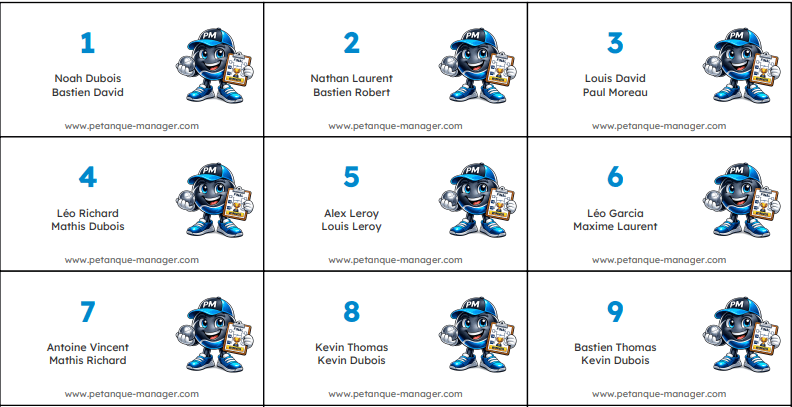
Example of badges for teams
4. Group stage (2 matches)
Each team plays at least 2 games against opponents from its group.
- Match 1: Team 1 vs Team 2 / Team 3 vs Team 4
- Match 2: winners play each other and losers play each other
Example of group in AB format
| Team | Results | Qualification |
|---|---|---|
| Equipe A | 2 victoires | Concours A |
| Equipe B | 1 victoire | Barrage |
| Equipe C | 1 victoire | Barrage |
| Equipe D | 0 victoire | Concours B |
5. Play-off match
The two teams with 1 win and 1 loss play a play-off match.
- The winner of the play-off joins Tournament A
- The loser of the play-off joins Tournament B
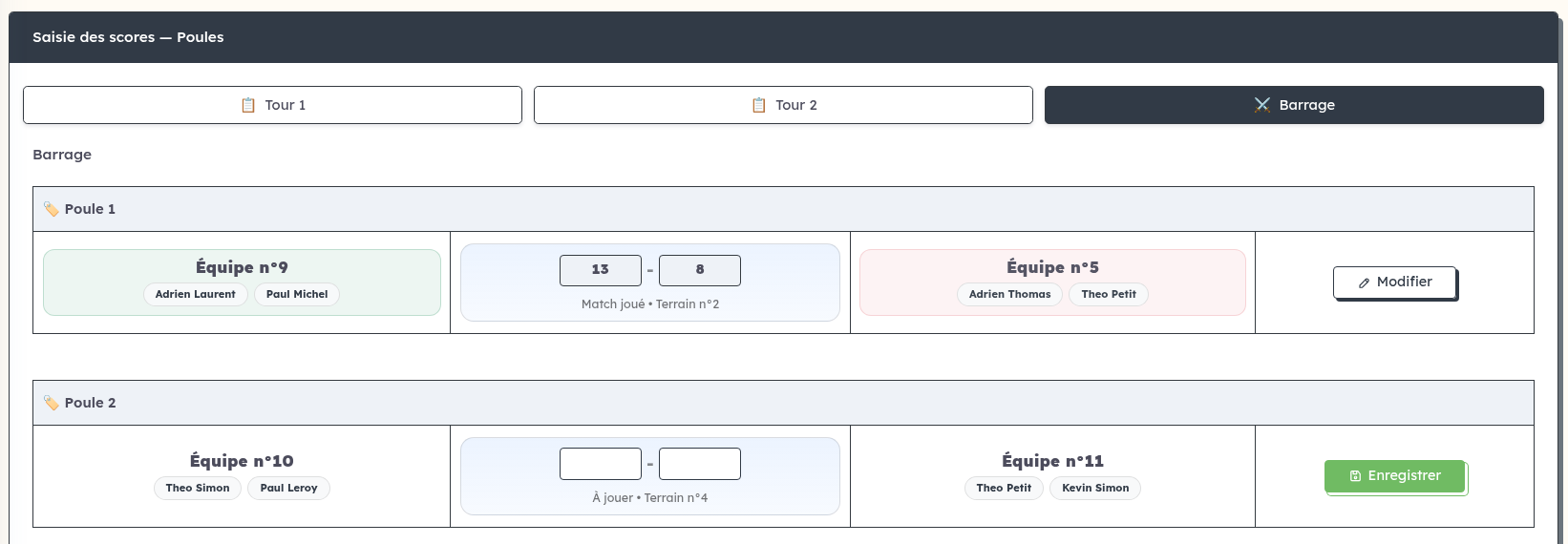
Play-off match to qualify for Tournament A or Tournament B
6. Knockout stages
Tournaments A and B then continue in single-elimination until the final.
- Tournament A: the number of rounds until the final depends on the number of registered teams.
- Tournament B: the same number of rounds as Tournament A.
7. Final result
- One winner for Tournament A
- One winner for Tournament B
The winner of a tournament is the team that wins the final.
8. Close the tournament
Once the final is over, you can close the tournament and archive the results. Results remain accessible at any time from the organizer’s profile or the tournaments page.
📱 Follow live results on your smartphone
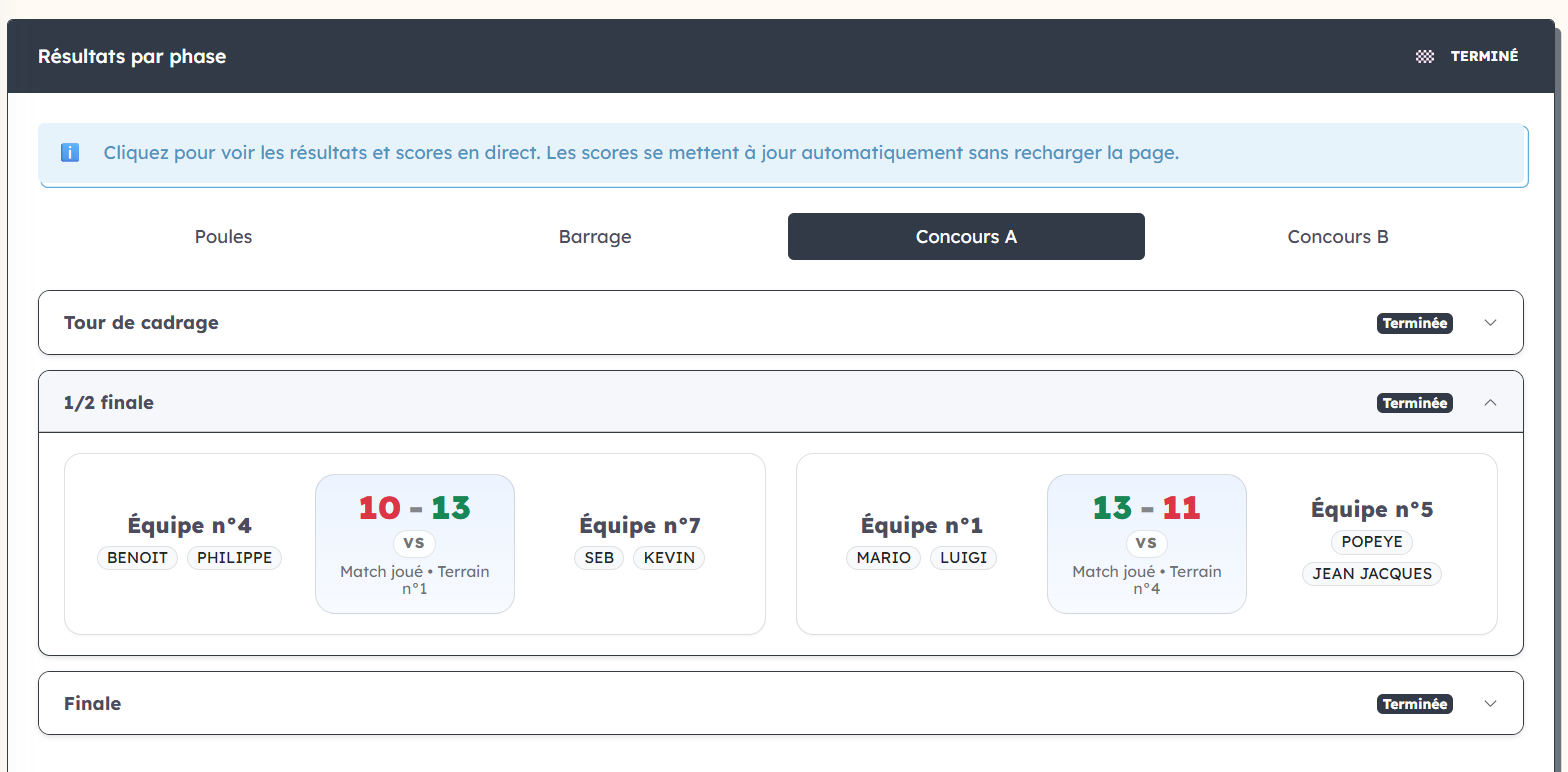
Players can follow the progress of the bracket in real time via a link or QR code. Results can be viewed directly on smartphones, tablets, or computers.
💡 Practical advice
- Plan for a number of teams that is a multiple of 4
- Ensure you have enough courts
- Clearly explain how the format works to the players
- Share live results with players via the tournament link or QR code